
The Real Cost of Low Wages
In last week's blog, I shared the story of an operations leader who was frustrated because his distribution centers were chronically understaffed.
The initial assumption was that we had a recruiting problem.
But once we started digging, we discovered something much bigger. Compensation, onboarding, training, leadership, culture, and career development were all contributing to the problem.
One of the first things we needed to rethink was compensation.
Our Pay Structure Wasn't Working
At the time, most distribution center employees had essentially the same job description. There wasn't much of a career path unless someone wanted to become a supervisor, and many didn't.
For everyone else, the primary opportunity to earn more was the annual merit increase. When you're starting with a relatively low hourly wage, a 3% increase doesn't create much incentive to stay, build new skills, or take on additional responsibilities.
We also realized we were looking at compensation too narrowly.
We had been comparing our wages with other distribution centers. But those weren't the only employers competing for our people. Employees could leave a physically demanding distribution job and potentially earn more doing less physically demanding work in a more comfortable environment.
Our labor market wasn't just other distribution centers. It was every employer competing for the same workers.
What If We Paid People More?
We developed a progressive wage structure that gave employees a clear path to increase their earnings by building their capabilities.
Instead of waiting for the annual merit cycle, employees could earn increases by learning and demonstrating proficiency in different parts of the operation. They could certify in areas such as unloading, stocking, loading trucks, and safely operating equipment. We also incorporated specific safety behaviors and expectations.
For employees interested in leadership, we created another path that included emotional intelligence and leadership development.
The concept was simple:
Learn more. Demonstrate proficiency. Contribute more. Earn more.
Getting everyone on board, however, wasn't quite so simple.
“Why Don't You Just Pay Us More?”
We encountered resistance from both employees and leaders, but for very different reasons.
Some employees initially believed they were already doing everything we were asking them to demonstrate. Their reaction was essentially, “We're already doing this. Just pay us the higher wage.”
But there was a difference between being able to perform a task and consistently performing it to the standard we needed.
Once employees began going through the certification process, the light bulbs started coming on. They recognized that proficiency meant more than simply knowing how to do the task.
Leadership had a different concern: the budget.
Paying people more meant increasing wages, and understandably, leaders wanted to know what the organization would get in return.
That's where we had to change the conversation.
Labor Cost Is More Than Hourly Wage
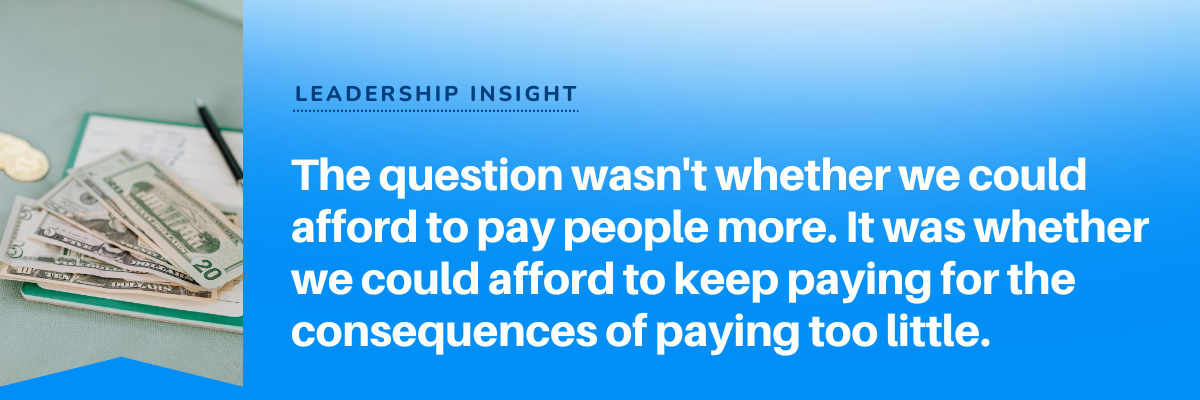
We weren't asking the organization to simply spend more money on wages. We were asking leaders to consider what they were already spending because the workforce wasn't stable.
Turnover, vacancies, overtime, recruiting, training replacements, safety incidents, mistakes, and lost productivity all have a cost.
So the question wasn't simply:
“How much will it cost us to pay people more?”
We also needed to ask:
“What is it costing us not to?”
Then We Watched the Numbers
We piloted the new approach and measured our results monthly. We didn't have to wait long to see movement.
Within the first few months, we began seeing improvements in the metrics as well as employee engagement. People had greater clarity about what was expected of them, could see their progress, and understood exactly what they needed to do to earn more.
Managers noticed the difference too.
As the pilot progressed, the results became increasingly clear:
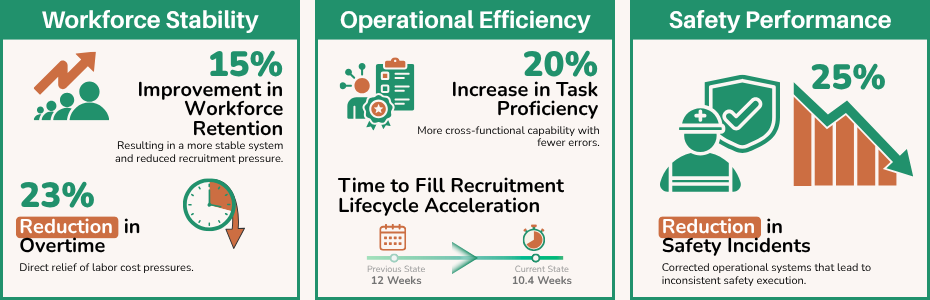
Those results didn't come from compensation alone, and that's an important distinction.
The progressive wage structure was part of a broader workforce strategy that also addressed training, safety, leadership, and other parts of the employee experience.
We didn't simply pay people more. We created a system where employees could see a path forward, build valuable skills, understand what great performance looked like, and earn more as their contribution increased.
In return, the organization gained a more capable, flexible, and stable workforce.
Look Beyond the Wage
When compensation is viewed primarily as an expense, it's easy to focus on keeping wages as low as the market will tolerate.
But workforce economics are more complicated than that.
An investment in one part of the workforce system can reduce costs somewhere else. The goal isn't to pay more simply for the sake of paying more. It's to understand how compensation affects retention, capability, safety, productivity, and the overall stability of the operation.
Sometimes the most important question isn't:
“What will this cost us?”
It's:
“What could this save us?”
Leadership in Practice
Look beyond the immediate cost.
When considering an investment in your workforce, don’t ask only, “What will this cost?” Also ask:
What problem are we trying to solve?
What is that problem costing us today?
Where could this investment reduce costs elsewhere?
What business outcomes should improve if it works?
How will we measure whether we’re getting a return?
The takeaway: Workforce investments shouldn’t be evaluated in isolation. A higher cost in one area can create significant savings and better performance across the operation.
Struggling with turnover, understaffing, or rising labor costs? The problem may be bigger than any one HR initiative. If you’d like help looking at the entire workforce system and identifying where to focus first, let’s talk.