
Building Decision Confidence
Last week, I wrote about the hidden cost of hero leaders: leaders who are always available to answer questions, solve problems, and step in when someone needs help.
But there’s another side to that problem.
Sometimes, the best thing a leader can do is not give someone the answer.
I recently watched this play out with a frontline leader who lacked confidence in their own decision making.
They frequently went to their manager and asked what they should do. It would have been easy for the manager to simply answer the question. After all, the manager had the experience and probably knew exactly what to do.
But instead, the manager kept pushing the decision back.
“You’re capable. You can do this. Make the decision.”
That might not feel like coaching. But it absolutely is.
The Fastest Answer Isn't Always the Best Answer
When someone comes to us with a problem, our instinct is often to solve it.
And for experienced leaders, that's usually pretty easy.
But every time we provide the answer, we may unintentionally teach the other person to come back the next time they face uncertainty.
Over time, a pattern develops.
The employee asks. > The manager answers. > The employee asks again.
Eventually, the manager wonders, Why can't they make a decision without me?
Sometimes, it's because we've trained them not to.
Build Confidence, Not Dependence
Developing capable leaders requires giving them opportunities to think through problems, make decisions, and experience the results.
Instead of immediately providing an answer, try asking:
What do you think we should do?
What options have you considered?
What are the risks?
If I weren't here, what decision would you make?
What do you need from me to feel confident moving forward?
There will absolutely be times when a manager needs to step in. Some decisions carry too much risk or fall outside the frontline leader's authority.
But many don't.
Those everyday decisions are opportunities to build judgment and confidence.
Leadership in Practice
When someone brings you a problem, are you helping them solve it, or teaching them how to solve it without you?
The next time someone asks, “What should I do?” resist the urge to immediately answer.
Ask them what they think first.
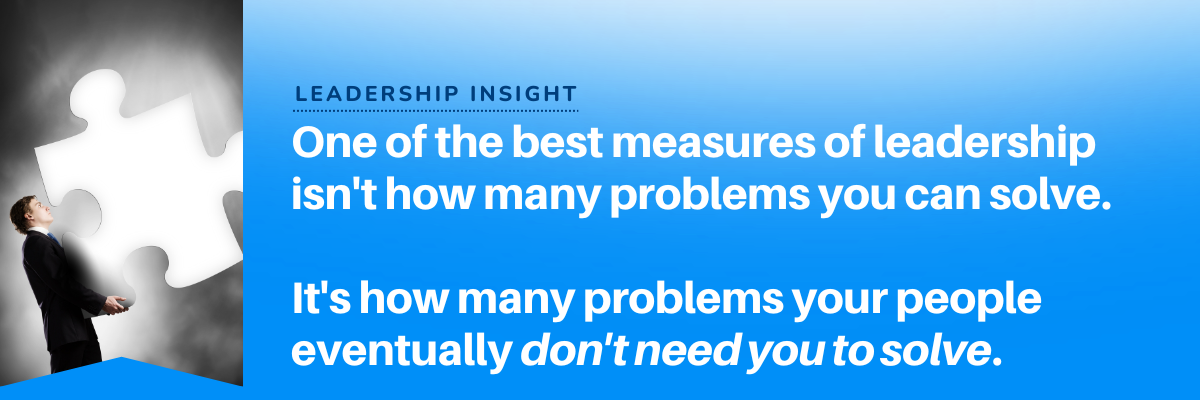
Because one of the best measures of leadership isn't how many problems you can solve.
It's how many problems your people eventually don't need you to solve.
If you’re trying to build stronger, more independent frontline leaders, I’d be happy to compare notes.